Salt Mine
The Deer KingThe Salt Mine is a place where imperial exploitation and disease meet: a site regarded by Aquafans as a sacred gift, but turned by Zolian rule into a slave-worked facility. Its outbreak becomes a starting point for investigating Black Wolf Fever, while later accounts recast the disaster as divine punishment for the mine’s defilement.
Setting and Political Context
The Salt Mine lies within a territory whose people were subject to sharply different imperial policies. After Aquafa became a province of the Zol Empire, its people received ordinary citizen status. The mountain clans of Toga, despite speaking Aquafa’s language and having defended its borders, were not recognized as Aquafans or as citizens by Zol. The former King of Aquafa could negotiate for their safety, but could not determine their status under the empire’s frontier administration.
Zolian policy relocated lower-caste populations to other conquered territories. Faced with the prospect of displacement, Gansa leaders devised a strategy of feigned resistance: the Lone Antlers would demonstrate the clans’ military usefulness, in the hope that Zol would allow them to remain as a buffer against Mukonia. The mine’s history sits within this wider system of conquest, classification, and forced movement, though the evidence does not identify it as the cause of the clans’ predicament.
The Outbreak and Investigation
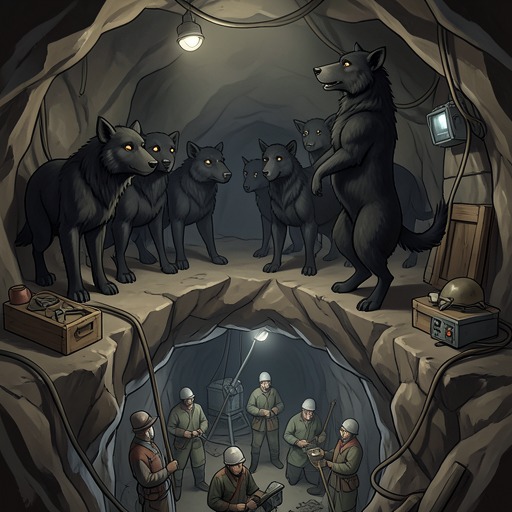
By the time Hohsalle raised the possibility of Black Wolf Fever, an outbreak had already occurred at the Salt Mine. He warned that if the animals implicated in an attack were diseased Ossam, precautions would be necessary. Exterminating the animals alone would not suffice: ticks or fleas could move from infected beasts to human hosts. He therefore proposed addressing both the animals carrying the disease and people who might have been infected, through a thorough plan carried out cautiously.
The mine outbreak gives the disease investigation an existing point of reference. Hohsalle treats it as a reason to prepare for further spread, while acknowledging uncertainty about the animals involved. His concern is not confined to identifying or killing a suspected animal source; it includes the possibility of transmission to people through parasites.
Sacred Meaning and Conflicting Explanations
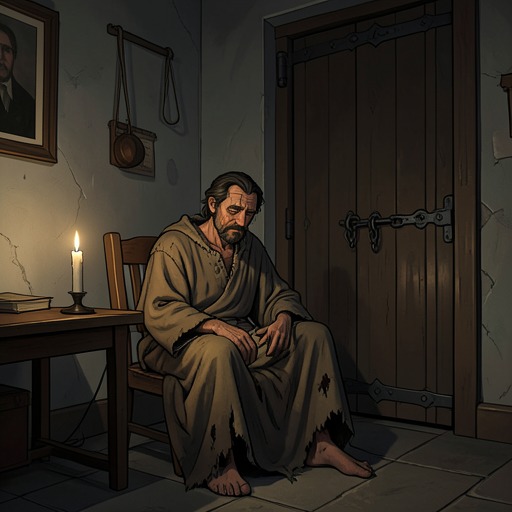
Tohma later connected the mine’s catastrophe to the death of its enslaved workers, recalling that it happened around the time he first met Van. He described the Salt Mine as a sacred place and a gift from the gods to Aquafa’s people, then contrasted that meaning with its conversion into a slave-worked site under Zolian rule. In his account, the mine was defiled, and the Hounds of the Gods struck there first.
Tohma’s explanation is presented as a belief circulating among people who interpret the epidemic through divine judgment, not as confirmation that supernatural agents caused it. He also wondered whether the pack he had seen in the forest had been Hounds of the Gods rather than Ossam, and questioned why it had spared him. Ohma dismissed this speculation, insisting that Tohma was Oki and lived honestly. The exchange shows how the mine’s history and the epidemic invite religious interpretations even as Hohsalle pursues a practical account of contagion.
People, Taxation, and Administrative Reach
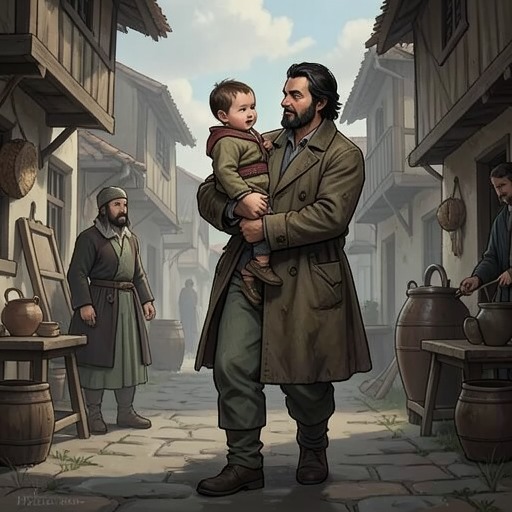
The pressures surrounding the mine’s world extend beyond the enslaved workers. Tohma’s family in Oki struggled to make ends meet while paying a head tax on every reindeer. Rates were lower for people with Zolian blood, but that advantage applied only to Kiya and Tohma. Ohma tried raising pyuika, which were taxed less heavily, but his lack of knowledge made the breeding effort fail, leaving the household near disaster.
Zolian rule also depended on detailed population records. Yotalu explained that tax officers collected information about nomadic groups in outlying areas, including Oki Valley and the Toga Mountains, recording the population and ages of people in each place. Some residents hid when officers came, so the records were not complete, but Yotalu believed they were accurate enough to help find Van. The same administrative reach that classified and taxed remote communities could thus serve other purposes, linking population management to the search for a person suspected of hiding in the woods.
Frontier Settlement and Significance
The empire’s frontier system also relied on poor farmers and herders from the edges of Zolian territory. When conquest expanded the borders, these settlers were ordered to establish Zolian-style communities: cultivating preferred crops and livestock, building towns according to Zolian methods, and mingling with conquered populations. They acted as an unarmed vanguard for transforming newly acquired land. In return, they received lower taxes than they would have paid at home, and land they cleared belonged to them; nevertheless, many grieved that they could never return to their native lands.
Together, the mine’s sacred status, its use of slave labor, the disease investigation, and the surrounding systems of taxation and settlement make it more than the location of an outbreak. It concentrates the conflict between local meaning and imperial use: a place understood as belonging to Aquafa is made to serve Zolian rule, and the epidemic that begins there is explained in radically different terms—as a problem of transmission to be managed or as punishment for a violation.